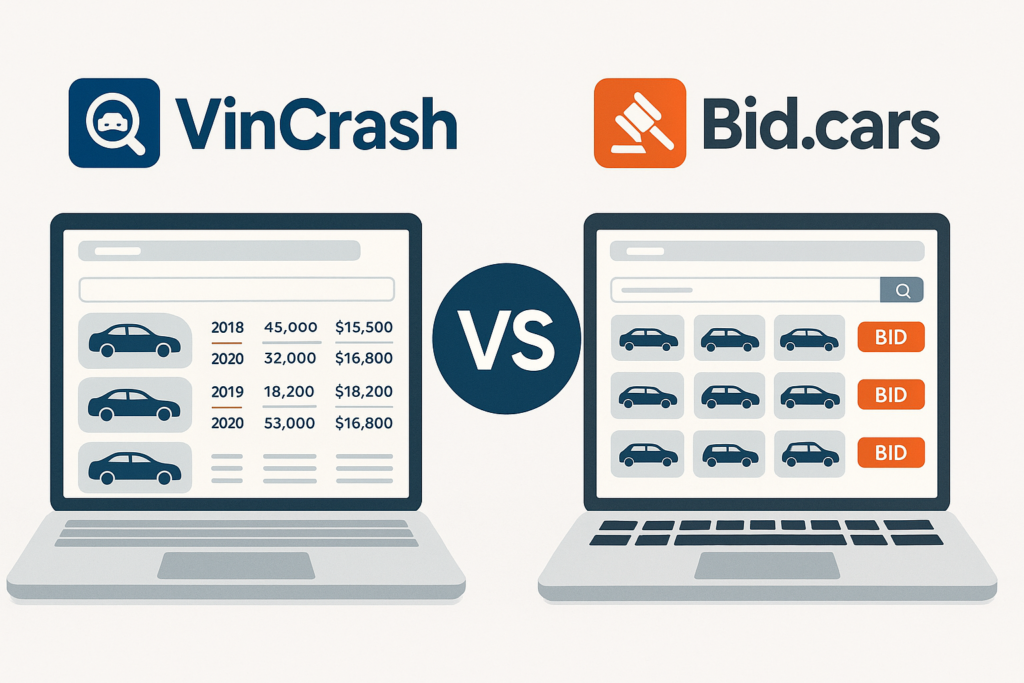
Both VinCrash and Bid.cars revolve around the same world: Copart, IAAI, US cars, auctions, imports. At first glance, therefore, they may seem very similar. In practice, they are two completely different approaches – and this is why many people, when looking for specific car data and auction archives, are quicker to “get along” with VinCrash than with Bid.cars
Here’s without the marketing gibberish: what VinCrash does, what Bid.cars does and why, in many situations, VinCrash will simply be a more convenient tool for analysis rather than for buying itself.
VinCrash is a service that focuses on the history of cars from Copart and IAAI and the auction archive. After entering either the VIN or the car’s details, you can see, among other things, bidding history, prices, photos, damage type and other auction data. The platform communicates very clearly that it offers a free check of auction history by VIN, with additional paid extended reports if someone needs a full vehicle history.
In short – VinCrash is ‘from looking at the numbers and pictures’, not from just buying.
Bid.cars, on the other hand, is an intermediary platform for the auction and import of cars. It allows you to search for vehicles from Copart and IAAI, to participate in auctions via their system (with a deposit), and to deal with the subject of transport, clearance, documents, etc.
In addition, Bid.cars’ ecosystem includes BidFax, a free archive of auction history from Copart and IAAI, a thematically similar tool to VinCrash, but embedded in a larger sales and import platform.
And this is where the first important difference comes in:
Bid.cars = buying tool
VinCrash = a tool for analysing and checking
Bid.cars tries to cover the whole process: from looking for a car, to bidding, to transport and documents. It’s great when you want someone to ‘do the importing for you’, but it can sometimes be overwhelming if you’re just interested in the dry data at that stage : for how much, when, in what condition.
VinCrash goes the other way:
If your goal is to understand the market first and then think about buying – such a bottleneck is simply more convenient.
Bid.cars earns money by brokering and handling imports. It therefore has a natural incentive to ultimately lead you to the purchase of a particular car – the whole process of registration, deposits, transport offers, etc. is subordinated to this.
VinCrash is in a much more ‘studious’ position – his task is:
It’s a different vibe using the service:
on VinCrash you have the feeling that no one is pulling you by the sleeve to buy, they are just suggesting data and the decision is left to you anyway.
On Bid.cars, to actually act – to bid on a car, to order a purchase – you have to:
It’s clear – that’s the auction broker model.
In the VinCrash world, the start is reversed:
you enter the VIN first and get the data about the car from the auction, including bidding history and, if you need it, the possibility to select a broader report about the vehicle.
Which is to say:
When bidding from the US, it is easiest to fall into two extremes:
The auction archive and VinCrash reports allow peace of mind:
Bid.cars also gives you access to the archive (BidFax), but it’s part of a larger platform geared towards handling the purchase and transport, so naturally you’ll be led more often towards ‘buy this car with our help’ rather than the cool analysis itself.
VinCrash works well here as a separate ‘common sense calculator’ that you can use before you start talking to a broker – be it Bid.cars or anyone else.
Simplest:
A better choice VinCrash, when:
A better choice of Bid.cars when:
In practice, therefore, many sensible buyers do just that:
Is VinCrash ‘objectively better’ than Bid.cars?
No – because it’s a bit like comparing Excel with a transport company. Each is used for something different.
But if we are talking about a tool for quietly analysing Copart/IAAI cars, bidding history and prices, then:
That’s why, the next time you have a US car in mind, a good, common-sense scheme looks like this:
First VinCrash for analysis → only then Bid.cars or another broker to buy.
And it is in this sense – in its role as a cool, independent ‘magnifier’ for auctions – that VinCrash just happens to be a better, calmer choice.